
From Voice to Everywhere
We typed one sentence: "Tell me about the White House." Our AI did the rest — including narrating it in Buddy's cloned voice.
AI Voice Clone
A preview of Buddy's AI-cloned voice — hear the full narration during the cinematic tour below ↓
The AI Goes To Work
Researching
Writing
Designing
Producing
3 AI models. 14+ content types. One click.
The Blog Post
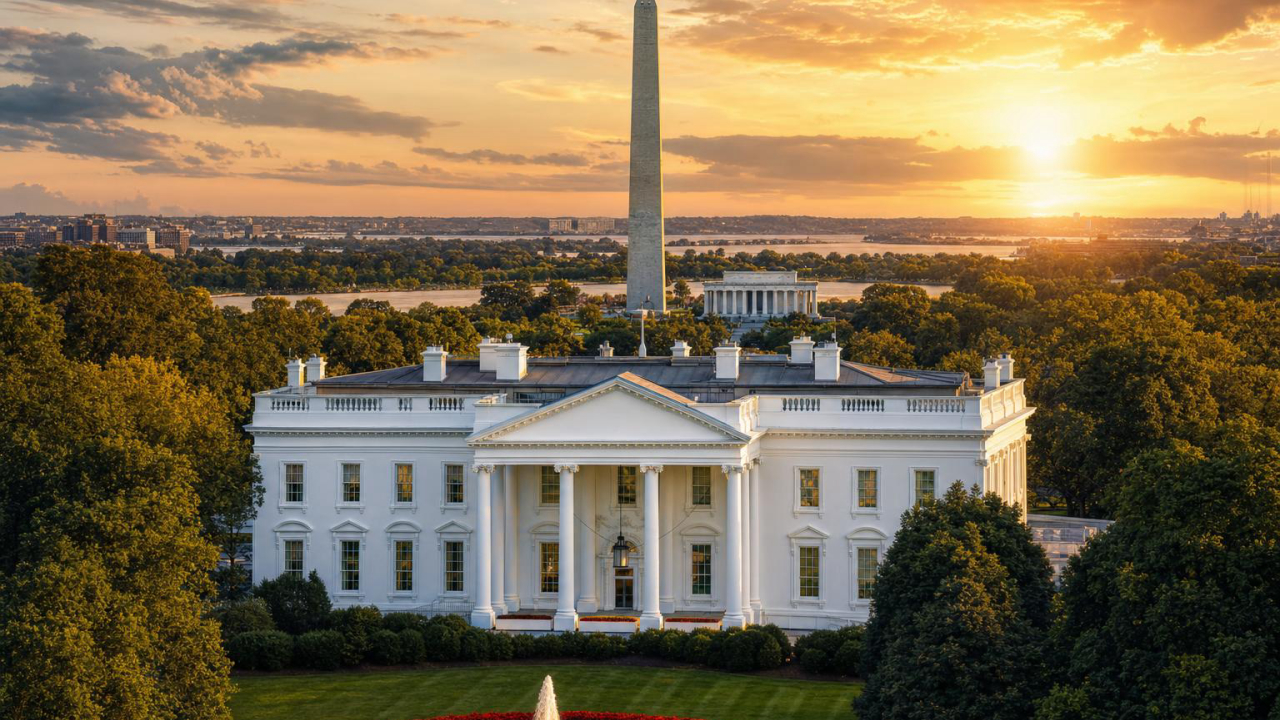
The Ultimate White House Property Tour
Introduction: Welcome to 1600 Pennsylvania Avenue
There is no address in the world quite like 1600 Pennsylvania Avenue NW, Washington, DC. It is a street number that carries the weight of history, the machinery of a global superpower, and the enduring symbolism of American democracy all rolled into one gleaming, neoclassical facade. I'm Buddy The Blogger, and today I'm taking you on an incredible, cinematic aerial journey across the world's most famous address and the monumental core that surrounds it. This isn't just a tour of a building — it's a flight across the beating heart of the United States government, its most sacred memorials, and its most treasured cultural institutions.
From the North Portico of the White House to the marble steps of the Lincoln Memorial, from the shimmering Tidal Basin to the solemn hillsides of Arlington National Cemetery, Washington, DC packs more history per square mile than almost anywhere else on Earth. Whether you're planning your first visit to the nation's capital, researching the architecture of American power, or simply love a great aerial adventure, this guide will walk you through every landmark, every waypoint, and every story hidden in the stones of this extraordinary city.
Grab your virtual boarding pass. We're about to climb into the sky above Pennsylvania Avenue, orbit the West Wing, glide across the National Mall, and land softly on the hallowed ground of Arlington. If you enjoy immersive travel storytelling like this, you'll want to explore more cinematic city breakdowns over at Buddy The Blogger, where we turn famous landmarks into unforgettable virtual journeys.
Key Takeaways
- The White House has served as the residence and office of every U.S. President except George Washington, standing at 1600 Pennsylvania Avenue NW since 1800.
- The National Mall connects the White House, Washington Monument, Lincoln Memorial, and U.S. Capitol in one continuous, walkable monumental core.
- The Lincoln Memorial sits less than a mile from the White House and boasts an incredible 4.8-star visitor rating.
- The Jefferson Memorial and Tidal Basin are famous worldwide for the springtime cherry blossom bloom.
- Arlington National Cemetery, just across the Potomac via the Arlington Memorial Bridge, is home to the Tomb of the Unknown Soldier and Arlington House.
- An immersive 3D interactive aerial map and cinematic AI-narrated tour lets you fly this entire route yourself, from your browser.
Table of Contents
- Introduction: Welcome to 1600 Pennsylvania Avenue
- The White House: History, Architecture & Iconic Rooms
- The Rose Garden & South Lawn
- National Mall Overview
- The Washington Monument
- The Lincoln Memorial
- The Thomas Jefferson Memorial
- The Smithsonian Museums
- The United States Capitol
- Arlington National Cemetery
- WWII Memorial & the Reflecting Pool
- Virtual Tour Experience
- Practical Visitor Tips
- Frequently Asked Questions
The White House: History, Architecture & Iconic Rooms
Our flight begins right where every great DC story begins: the iconic North Portico of the White House, the ceremonial front entrance that has welcomed kings, prime ministers, dignitaries, and everyday citizens for more than two centuries. Designed by Irish-born architect James Hoban and completed in 1800, the White House is the oldest public building in Washington, DC, and it remains the only private residence of a head of state that is open, in part, to public tours free of charge.
Hoban modeled the mansion loosely on Leinster House in Dublin, giving the building its distinctive Neoclassical proportions — a style meant to evoke the dignity and permanence of the young American republic. Constructed from Aquia Creek sandstone and painted white almost from the very beginning (though the "White House" nickname wasn't made official until Theodore Roosevelt formally adopted it in 1901), the building has survived fire, war, and dozens of renovations while retaining its essential identity.
During the War of 1812, British troops set fire to the White House in August 1814. Legend holds that a sudden, violent thunderstorm helped douse the flames and saved the structure from complete destruction. Only the exterior walls survived, and James Hoban was brought back to oversee the reconstruction.
The West Wing: The Nerve Center of Power
As our aerial camera orbits the West Wing, we're looking at the true nerve center of American executive power. Built in 1902 under President Theodore Roosevelt and expanded significantly by William Howard Taft in 1909, the West Wing houses the Oval Office, the Cabinet Room, the Roosevelt Room, and the Press Briefing Room. It is here that presidents sign legislation, meet with foreign heads of state, and address the nation during moments of crisis and triumph alike.
The Oval Office itself, with its curved walls and iconic Resolute Desk, has become shorthand in American culture for presidential authority. Nearly every modern president has redecorated the room to reflect their personal taste, yet its oval shape — a nod to the formal reception rooms of 18th-century architecture — has remained a constant symbol of the presidency since 1909.
The South Portico and Grand Facade
Sweeping around from the West Wing, the grand South Portico comes into view, offering some of the most iconic and instantly recognizable views of the entire complex. This curved, columned balcony overlooks the expansive South Lawn and has served as the backdrop for countless official photographs, helicopter departures aboard Marine One, and televised addresses.
The South Portico's semicircular design, added in 1824, gives the White House its familiar, gently rounded southern silhouette — instantly distinguishable from the flatter, more formal North Portico that greets visitors arriving from Pennsylvania Avenue.
Inside the Mansion: Rooms of History
While our flight today stays above the rooftops, it's worth remembering what lies inside those historic walls. The White House contains 132 rooms, 35 bathrooms, 412 doors, 147 windows, eight staircases, and three elevators spread across six floors. Famous interior spaces include the State Dining Room, the Blue Room, the Red Room, the Green Room, and the East Room — the largest room in the house, used for press conferences, bill signings, and star-studded state dinners.
For anyone fascinated by presidential history and architecture, the White House offers an unmatched case study in how a single building can evolve alongside a nation, absorbing new technology, new security demands, and new generations of first families while never losing its essential 18th-century soul.
The Rose Garden & South Lawn
Just below the South Portico lies the beautiful Rose Garden, one of the most historically significant landscaped spaces in the entire country. First planted in 1913 under Ellen Wilson and redesigned in 1962 at the direction of President John F. Kennedy and First Lady Jacqueline Kennedy, the Rose Garden has become the go-to setting for major press conferences, bill signings, state ceremonies, and diplomatic announcements.
Its simple, elegant layout — a rectangular lawn framed by flowering crabapple trees, boxwood hedges, and seasonal blooms — was intentionally designed to provide a dignified outdoor stage just steps from the Oval Office. Countless defining moments in American history have unfolded on this small patch of grass, from treaty signings to Medal of Honor ceremonies.
The South Lawn: Stage for State Arrivals
Beyond the Rose Garden, the sprawling South Lawn serves as the backdrop for official state arrivals, military honor ceremonies, and the beloved annual White House Easter Egg Roll — a tradition dating back to 1878 under President Rutherford B. Hayes. The South Lawn is also where Marine One, the president's helicopter, lands and departs, offering some of the most dramatic aerial photography of the entire complex.
Beyond the White House gates, the Ellipse and President's Park form a green connective tissue linking this historic home to the grandest monuments of the capital. The Ellipse hosts the National Christmas Tree each winter and serves as a launching point for countless parades, rallies, and public gatherings throughout the year.
National Mall Overview
From the air, nothing captures the genius of Washington's urban planning quite like the National Mall. Stretching nearly two miles from the steps of the U.S. Capitol to the Lincoln Memorial, this open, tree-lined greenway forms the literal and symbolic spine of the nation's capital. Pierre L'Enfant's original 1791 city plan envisioned a grand ceremonial avenue connecting the "Congress House" with the President's House, and while the finished product took over a century to fully realize, the result is one of the most successful pieces of civic design in world history.
Flying along this corridor, you pass the Washington Monument, the World War II Memorial, the Reflecting Pool, and the Lincoln Memorial in rapid succession — each one perfectly aligned along a single sightline that stretches from Capitol Hill all the way to the Potomac River. This is the Monumental Core, and it remains the ceremonial stage for presidential inaugurations, national celebrations, historic protests, and millions of visitors every single year.
Flanking the Mall on both sides are the world-famous Smithsonian museums, making this two-mile stretch arguably the most culturally dense walkway on the planet. If you love discovering how great cities organize their history and civic identity into a single unforgettable experience, you'll find plenty more inspiration among the travel features at Buddy Blake.
The Washington Monument
To the east of the Reflecting Pool stands the towering Washington Monument, soaring 555 feet, 5 inches into the DC skyline and visible from nearly every corner of the city. Just a quick three-minute drive from the White House, this obelisk is dedicated to the nation's first president and remains the tallest structure in Washington, DC — a status protected by a longstanding building height restriction that keeps the capital's skyline famously low-rise.
Construction on the monument began in 1848 but stalled for over two decades due to funding shortages and the Civil War — a pause still visible today in a subtle change of marble color roughly 150 feet up the shaft, where construction resumed in 1879 using stone from a different quarry. The monument was finally completed in 1884 and dedicated in 1885, standing for decades afterward as the tallest structure in the entire world.
At the time of its completion in 1884, the Washington Monument was the tallest man-made structure on Earth, a title it held until the Eiffel Tower surpassed it in 1889.
Visitors today can ride an elevator to the observation deck near the top, taking in sweeping 360-degree views across the National Mall, the Potomac River, and the surrounding monumental core — the very same perspective our cinematic aerial flight captures from above.
The Lincoln Memorial
We now approach the western end of the National Mall, heading toward one of America's most sacred shrines. Here stands the majestic Lincoln Memorial, situated less than a mile from the White House and carrying an incredible 4.8-star visitor rating — a testament to just how deeply this monument resonates with everyone who climbs its marble steps.
Designed by architect Henry Bacon and modeled after the ancient Greek Parthenon, the Lincoln Memorial was dedicated in 1922 and features 36 Doric columns, one for each state in the Union at the time of Lincoln's death. Inside sits Daniel Chester French's monumental seated statue of Abraham Lincoln, flanked by inscriptions of the Gettysburg Address and Lincoln's Second Inaugural Address carved directly into the chamber walls.
A Stage for American History
Beyond its architectural grandeur, the Lincoln Memorial has become one of the most important stages for American civil discourse. It was here, on these very steps, that Dr. Martin Luther King Jr. delivered his "I Have a Dream" speech during the 1963 March on Washington for Jobs and Freedom — an event that helped define the entire civil rights movement.
Looking east from Lincoln's steps, visitors take in a breathtaking panoramic sweep of the entire National Mall, with the Reflecting Pool stretching toward the Washington Monument and the Capitol Dome rising in the far distance. It's widely considered one of the single best photographic vantage points in the entire country, and our aerial footage captures this sightline in full cinematic glory.
WWII Memorial & the Reflecting Pool
Flying south from the White House grounds, we encounter the World War II Memorial, a stunning tribute located just over half a mile away. Dedicated in 2004, this memorial honors the 16 million Americans who served in the U.S. armed forces during World War II, along with the more than 400,000 who died, and the millions more who supported the war effort from home.
The memorial's design features 56 granite pillars arranged in a semicircle, each representing a U.S. state or territory at the time of the war, surrounding a central plaza and fountain. A Freedom Wall lined with 4,048 gold stars commemorates the fallen, each star representing 100 American service members lost.
Just beyond the memorial, we glide over the Lincoln Memorial Reflecting Pool, a peaceful mirror stretching nearly 2,000 feet that reflects the nation's history in perfectly still water. On calm mornings, the pool captures a flawless reflection of the Washington Monument and Lincoln Memorial alike, creating one of the most photographed symmetrical views in the entire country.
The Thomas Jefferson Memorial
Turning south from the Lincoln Memorial, the shimmering waters of the Tidal Basin come into view, famous around the world for its springtime cherry blossoms — a gift of 3,000 trees from the city of Tokyo in 1912 that now draws over a million visitors each spring during the National Cherry Blossom Festival.
On the far shore of the Tidal Basin sits the neoclassical Thomas Jefferson Memorial, located just over a mile from the White House. Dedicated in 1943 on the 200th anniversary of Jefferson's birth, the memorial was designed by architect John Russell Pope, who drew direct inspiration from the Pantheon in Rome — a style Jefferson himself famously admired and incorporated into his own architectural designs at Monticello and the University of Virginia.
Inside the memorial's circular colonnade stands a 19-foot bronze statue of Jefferson, surrounded by engraved excerpts from the Declaration of Independence and his other writings on liberty and self-governance. This angle showcases the Jefferson Memorial framed beautifully against the classic low-rise Washington skyline, a view made possible by the very height restrictions the Washington Monument helped inspire.
The Smithsonian Museums
Heading back toward the Mall, the distinctive red sandstone of the Smithsonian Institution Castle immediately stands out against the surrounding white marble. Completed in 1855, this Norman-style building serves as the administrative headquarters and visitor center for the entire Smithsonian Institution — the largest museum, education, and research complex in the world.
National Air and Space Museum
Nearby, the world-renowned National Air and Space Museum inspires millions of visitors every year with its collection of historic aircraft and spacecraft, including the Wright Brothers' original 1903 Flyer and the Apollo 11 command module. As one of the most visited museums on Earth, it stands as a powerful testament to American innovation and the boundless curiosity that drives exploration both in the sky and beyond it.
National Gallery of Art
To the north of the Mall, the National Gallery of Art houses some of the world's finest masterpieces, spanning centuries of Western art from medieval altarpieces to modern abstract works. Its East and West Buildings, connected by an underground concourse, together form one of the premier art destinations in North America — and admission remains completely free, a hallmark of the Smithsonian's broader mission of open public access to knowledge and culture.
Together, the Smithsonian museums lining the Mall represent one of the greatest concentrations of free cultural and educational resources anywhere on the planet, drawing tens of millions of visitors annually from every corner of the globe.
The United States Capitol
We now fly eastward, approaching the majestic seat of the United States Congress on Capitol Hill. The magnificent United States Capitol Dome rises ahead, a symbol of democracy recognizable worldwide and one of the most photographed government buildings on Earth.
Construction on the Capitol began in 1793, with George Washington himself laying the cornerstone. The current cast-iron dome, completed in 1866 during the Civil War, replaced an earlier, smaller dome and stands 288 feet tall, topped by the Statue of Freedom — a bronze figure representing liberty and Union.
The Capitol houses both chambers of Congress: the House of Representatives in the south wing and the Senate in the north wing. Between them lies the Rotunda, a soaring circular hall decorated with historical paintings and Constantino Brumidi's famous fresco, "The Apotheosis of Washington," painted directly onto the interior of the dome itself.
The West Front View
The West Front of the Capitol offers a commanding view down the entire length of the National Mall, all the way to the Lincoln Memorial nearly two miles away. This is the same vantage point used for every presidential inauguration since Ronald Reagan's first swearing-in in 1981, making it one of the most historically significant sightlines in all of American democracy.
Arlington National Cemetery
Crossing back over the Potomac River, the grand Arlington Memorial Bridge links the city to Virginia, its neoclassical arches designed specifically to create a symbolic connection between the Lincoln Memorial and Arlington National Cemetery — a deliberate architectural gesture linking the North and South in the wake of the Civil War.
We pass over Arlington National Cemetery, a deeply moving landscape of honor and remembrance spanning 639 acres and containing the graves of more than 400,000 active-duty service members, veterans, and their families. Rows of simple white headstones stretch across rolling hills in perfect, solemn formation, visible strikingly from the air.
Arlington House & the Tomb of the Unknown Soldier
High on the hill sits Arlington House, the former home of Confederate General Robert E. Lee, overlooking the eternal flame at President John F. Kennedy's gravesite and the Tomb of the Unknown Soldier. Guarded around the clock, 365 days a year, by the elite Old Guard regiment, the Tomb of the Unknown Soldier honors unidentified service members from World War I, World War II, and the Korean War, and stands as one of the most solemn and revered memorials in the entire country.
The Tomb Guard sentinels take 21 steps during their walk across the tomb, pause for 21 seconds, then repeat the process — a silent tribute echoing the 21-gun salute, the highest honor given in the U.S. military.
Panoramic Views & the Monumental Core
Pulling back for a sweeping panoramic view, we can truly appreciate how beautifully the entire National Mall is laid out — a masterclass in civic geometry connecting the Capitol, the Washington Monument, the Lincoln Memorial, and the White House along carefully aligned axes. To the north, the Potomac River flows past the vibrant and historic Georgetown Waterfront, adding a lively, modern contrast to the historic gravity of the monuments nearby.
This spectacular overview of the Monumental Core showcases the perfect alignment of American history — centuries of architecture, memory, and governance compressed into a few square miles, all designed to be experienced on foot, by car, or, as we've done today, from high above in cinematic aerial flight.
Returning to the executive grounds, we see the West Wing alongside the grand Eisenhower Executive Office Building, a stunning French Second Empire-style structure completed in 1888 that now houses much of the White House staff. To the east, the East Wing stands adjacent to the historic Treasury Department building, itself one of the oldest departmental buildings in the entire federal government, dating to 1836.
We close our flight with one final, stunning view of the White House, standing proud at the heart of the nation — a fitting bookend to a journey that has taken us across two centuries of American history in a matter of minutes.
Virtual Tour Experience
Everything you've just read about can be experienced firsthand through our immersive 3D interactive aerial map and cinematic AI-narrated tour. Instead of simply reading about the North Portico, the Rose Garden, or the Tomb of the Unknown Soldier, you can actually fly the entire route yourself — swooping from 1600 Pennsylvania Avenue down the National Mall, across the Tidal Basin, over Capitol Hill, and finally across the Potomac to Arlington, all rendered in stunning three-dimensional detail.
Our virtual tour technology stitches together satellite imagery, elevation data, and precise waypoint choreography to recreate the exact flight path described in this article — the same North Portico approach, West Wing orbit, South Lawn sweep, and Capitol Dome flyby you've just read about, brought to life with smooth cinematic camera movement and full AI narration guiding you every step of the way.
This isn't a static map or a flat photo gallery. It's a living, breathing aerial experience that lets you explore the geography of Washington, DC exactly as our flight covered it: orbiting landmarks, gliding along the Mall's central axis, and descending gently over Arlington's rolling hills. Whether you're planning an actual trip to the capital or simply want to experience its grandeur from your couch, this interactive 3D map offers the closest thing to actually piloting your own aerial tour over the nation's most important address.
For more cinematic virtual explorations of the world's greatest landmarks, be sure to browse the growing collection of aerial city tours at Buddy The Blogger, and check out additional immersive travel content over at Buddy Blake.
Practical Visitor Tips
Planning an in-person visit to follow up on your virtual flight? Here are some essential practical tips gathered from decades of collective visitor experience in Washington, DC:
- White House Tours: Public tours must be requested through your Member of Congress months in advance and are subject to strict security screening. Plan early.
- Best Time for Cherry Blossoms: The Tidal Basin's cherry trees typically peak between late March and early April, but exact timing varies by year based on weather.
- Walking the Mall: The distance from the Capitol to the Lincoln Memorial is nearly two miles one-way — wear comfortable shoes or consider the DC Circulator bus.
- Smithsonian Admission: All Smithsonian museums on the Mall are completely free, though some special exhibits may require timed passes.
- Arlington National Cemetery: Allow at least two to three hours to properly visit Arlington House, the Tomb of the Unknown Soldier, and the Kennedy gravesite.
- Best Sunset Photos: The Lincoln Memorial steps at golden hour, looking east across the Reflecting Pool, offer one of the most rewarding photo opportunities in the entire city.
Frequently Asked Questions
How far is the Lincoln Memorial from the White House?
The Lincoln Memorial sits less than a mile from the White House, making it an easy and scenic walk along the National Mall.
How tall is the Washington Monument?
The Washington Monument stands 555 feet, 5 inches tall, making it the tallest structure in Washington, DC, and it is located just a three-minute drive from the White House.
Can visitors go inside the White House?
Yes, but public tours must be arranged in advance through a Member of Congress and are subject to background checks and strict security screening.
What is the distance between the White House and the Jefferson Memorial?
The Thomas Jefferson Memorial is located just over a mile from the White House, on the far shore of the Tidal Basin.
Why does the Jefferson Memorial look like the Pantheon?
Architect John Russell Pope intentionally designed the memorial in the neoclassical style Thomas Jefferson himself admired, drawing direct inspiration from the ancient Roman Pantheon.
What is the significance of the World War II Memorial's 56 pillars?
Each of the 56 granite pillars represents a U.S. state or territory that contributed to the American war effort during World War II.
How is Arlington National Cemetery connected to the National Mall?
The Arlington Memorial Bridge directly links the Lincoln Memorial to Arlington National Cemetery, symbolizing unity between North and South after the Civil War.
Are the Smithsonian museums really free?
Yes, admission to all Smithsonian Institution museums along the National Mall, including the National Air and Space Museum and the National Gallery of Art, is completely free of charge.
What rating does the Lincoln Memorial have from visitors?
The Lincoln Memorial holds an incredible 4.8-star visitor rating, reflecting its profound historical and emotional impact on nearly every visitor.
Can I experience this tour virtually before visiting in person?
Absolutely. Our immersive 3D interactive aerial map and cinematic AI tour let you fly this exact route — from the White House to Arlington National Cemetery — entirely online, helping you plan a smarter, more informed in-person visit.
14+ Content Types
Google Business
🏛️ Explore the iconic White House like never before with our exclusive property tour! 🌟 Discover the rich history, stu...
Experience the grandeur of the White House like never before! 🌟 Join us for an exclusive property tour that takes you t...
YouTube Description
Join us for an exclusive tour inside the White House, the most iconic residence in America! 🏛️ In this video, we explor...
Email Template
Step Inside History: The White House Tour Dear History Enthusiast, Ever wondered what it's like inside the White House? ...
AI Podcast

The Ultimate White House Property Tour
This entire podcast was generated by AI — using Buddy's cloned voice to answer questions naturally.
Thumbnail Suite
Original (16:9) YouTube Preview
 Blog Size (800x450)Podcast Square (1:1)
Multiple platform-optimized images. Auto-generated instantly.
3D Property Explorer
Interactive 3D terrain, automated cinematic orbits, and comprehensive parcel data — fully embeddable.
All of this.
From a 2-minute voice recording.
Imagine what you could create for YOUR properties and market updates.