📋 Episode Chapters
Episode Summary
Show Notes
📝 Full Episode Transcript
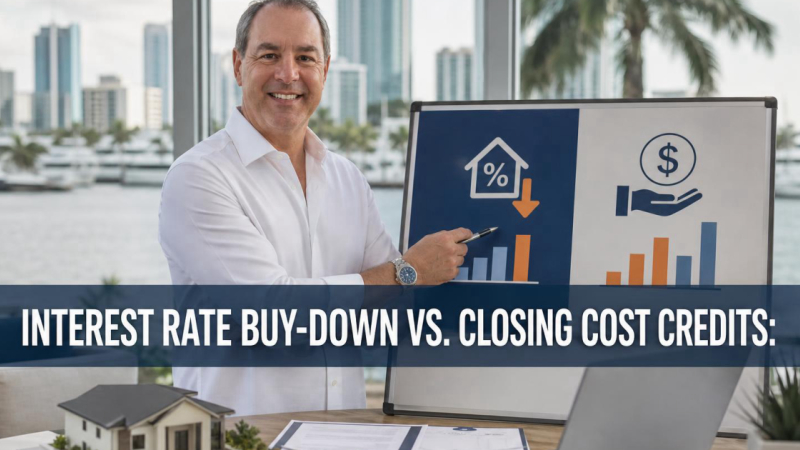
Full Episode Transcript: Interest Rate Buy-Down vs. Closing Cost Credits: Which Seller Concession Wins in 2026?
This is the complete, auto-generated transcript of the episode. Timestamps are provided for quick reference.
Welcome back to My Real Estate Podcast with David Libertor. I'm your host. And today, we're diving into something that's actually pretty crucial for sellers right now, figuring out whether to offer an interest rate buy-down or closing cost credits to attract buyers.
David, thanks so much for being here. Hey, thanks for having me. Yeah, this is such a relevant question because a lot of sellers are asking themselves this exact thing right now.
They want to make their offer more attractive, but they're not sure which direction to go. And honestly, the answer really depends on the market conditions and what buyers actually need.
Okay, so let me ask you this. When we talk about an interest rate buy-down, what exactly are we talking about here? Because I think a lot of people hear that term and they're not totally sure what it means.
Great question. So an interest rate buy-down is when a seller or sometimes a builder pays points up front to lower the buyer's interest rate for a certain period of time.
The most common one you see is a 2-1 buy-down, where the rate is reduced by 2% in year one, 1% in year two, and then it goes to the full market rate in year three.
It's basically the seller paying a lump sum at closing to reduce what the buyer pays in interest over those first couple years. Oh, that's really interesting.
So the buyer gets immediate relief on their monthly payment, right? That's got to be attractive to them. Exactly.
And that's the appeal. Lower monthly payments right out of the gate when they're probably feeling the most financially stretched. But here's the thing.
Closing cost credits work differently. With those, the seller is basically giving the buyer money at closing to cover some or all of their closing costs. So instead of the buyer coming out of pocket for appraisal fees, title insurance, inspections, all that stuff, the seller covers it.
So one is about the monthly payment and one is about upfront cash. I can see how both would be appealing, but in different ways.
So which one actually wins or does it depend? It totally depends. And that's the honest answer. If you're in a buyer's market and rates are high, a buy-down can be a game changer because buyers are really focused on affordability
and keeping that monthly payment down. But if you're in a market where buyers are stretched thin on cash, maybe they're first-time homebuyers or they didn't plan to have liquid funds available, closing cost credits might be the winner
because they solve an immediate problem. The buyer might not even have the cash to close without help. So it's really about understanding who your buyer is and what their actual pain point is.
That makes sense. What about from a seller's perspective? Is one more expensive than the other? Good point.
So the cost of a buy-down varies based on how many points you're buying down and what the market rate is. A 2-1 buy-down might cost anywhere from 2% to 4% of the loan amount, depending on the rate environment.
Closing cost credits are usually capped by lenders, typically at 3% to 6% of the purchase price, so you know you're sealing. But here's what's interesting.
A buy-down might actually cost less upfront, but the buyer benefits over time, whereas closing cost credits are purely an upfront expense for the seller with no ongoing benefit.
Oh, wow. So you're saying the buy-down could be more cost-effective for the seller in some situations? That's not what I would have assumed.
It can be, yeah. And another thing to consider is that a buy-down can actually help a buyer qualify for a larger loan because their effective payment is lower in those first years.
So if you have a buyer who's borderline on qualification, a buy-down might push them over the line. Closing cost credits don't affect qualification at all. They just help with the cash crunch at closing.
So if you're trying to expand your pool of potential buyers, the buy-down might actually be the smarter play. Potentially, yes. But you also have to think about market psychology.
Some buyers see closing cost credits and think, great, I can walk in with more cash in my pocket. Others see a buy-down and think my payment is gonna be manageable.
It really comes down to what the market is telling you about what buyers need right now. This has been super helpful, David. So basically, sellers should be thinking about their specific market, their specific buyer pool, and what's actually gonna move the needle for them.
It's not a one-size-fits-all answer. That's exactly right. Talk to your real estate agent. Look at what's working in your market and understand who's actually buying homes like yours.
Then make the call. Both are legitimate tools. You just have to use the right one for the job. Love that.
David, thanks so much for breaking this down. This is gonna help a lot of sellers make a smarter decision. Really appreciate it. Thanks for having me.
Always happy to talk real estate.
About the Host

Get Your Free Home Valuation from David Liberatore
Whether you're thinking about selling, refinancing, or just curious — get an instant, free home valuation report with neighborhood comparisons and market trends.